
.svg)
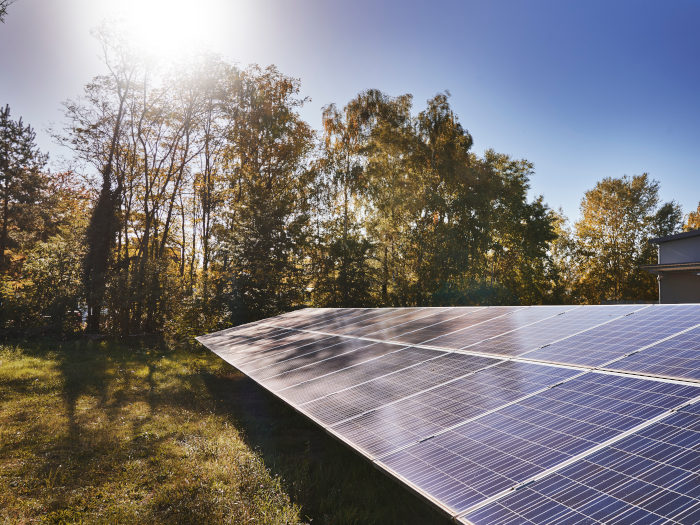
Climate change scenarios often rely on bioenergy, which could require massive amounts of land and impact food production and nature. However, this study using LandSyMM, led by Edingburgh with contribution by Almut and others at IMKIFU shows that agrivoltaic systems—which combine solar energy with farming—could produce the same energy using 30 times less land, benefiting ecosystems and reducing water and fertilizer use. The findings highlight that prioritizing agrivoltaics and solar panels over bioenergy could help avoid future farmland expansion while supporting both energy needs and nature protection.
Learn more
Nature-based solutions can protect society from climate and weather extremes, while also delivering a wide range of environmental, social and economic benefits, such as cleaner water, greater biodiversity, recreational spaces and improved human health and well-being. However, these co-benefits are often overlooked because their full value is difficult to assess, which holds back investment and slows their uptake, including by the insurance and financial sectors. So, how can we quantify the value of nature-based solutions beyond risk reduction? A new paper by Andrea Staccione, Almut Arneth and colleagues from the CMCC Foundation and Vrije Universiteit Amsterdam reviews the methods available to assess these co-benefits.
Learn more
This year we met at Georg-von-Vollmar - Akademie in Kochel am See for our group retreat.
We discussed the dynamics and organization within our group, learned more about AI tools in science, and found solutions for our group's internal data management. Besides that, we also found some free time to take a walk by the lake.

Carolina collaborated with colleagues from the Chair for Artificial Intelligence in Climate and Environmental Sciences on a newly published study in Machine Learning: Earth. They benchmarked seven deep learning models against two baseline approaches for next-day wildfire danger prediction in the Mediterranean region. They also applied explainable AI techniques to evaluate whether the models learned physically meaningful wildfire relationships rather than relying solely on predictive accuracy.
Learn more
Carolina led the review study “Deep Learning for Satellite-Based Forest Disturbance Monitoring: Recent Advances and Challenges,” published in WIREs, in collaboration with colleagues across Germany and the US. In this work, the authors identify three main technical avenues to address current limitations in forest disturbance detection, attribution, and training data scarcity: spatiotemporal architectures, embeddings and geospatial foundation models, and learning approaches designed for limited labelled data. The review further emphasizes that progress toward large-scale, reliable forest monitoring will require improved benchmark datasets, stronger interdisciplinary collaboration, and more open and standardized data-sharing practices.
Learn more
April 28-30 the LPJ-GUESS community met for their annual hybrid meeting, discussing latest developments and having fun at KIT-Campus Alpin (IMKIFU) in Garmisch-Partenkirchen. The photo shows the in-Person participants.
Learn more
Tobias led the study "Between a log and a hard place: European forests under competing demands", published in the European Journal of Forest Research, in collaboration with Almut and colleagues from KIT, TUM, and University of Freiburg. The review demonstrates that European forests cannot simultaneously deliver on policy demands for carbon storage, timber, bioenergy, and biodiversity. Climate change intensifies these conflicts. We argue that sustainable forest management requires better adaptation strategies alongside reduced demand for forest resources.
Learn more
C4LaNd is a new, DFG funded research training group that addresses the problem how to meet the ever-increasing and often conflicting demands on land for food, renewable energy, and materials without compromising biodiversity conservation and climate action. All positions offer a multidisciplinary, international research environment, with partners in Germany (Karlsruhe Institute of Technology & University of Hohenheim) and Australia (University of Melbourne). Positions are now open for application up to May 17th.
Learn more
Jens, Almut, Peter and Moritz, together with Mike Harfoot, have published a version of LPJ-GUESS which implements herbivory. The corresponding reduction in leaf biomass is determined by a process-based, dynamic model of the whole trophic pyramid (the Madingley Model). We have advanced the field of integrating animal-vegetation interactions in ecosystem modelling, once again and are proud to present this study. An application of the presented model system will also enter the peer-review process soon.
Learn more
Almut led the study "The biodiversity-climate-food nexus: Illustrating challenges and solutions using the Green Shoots framework" in One Earth. It highlights the importance of coordinating environmental policies and their implementation to avoid trade-offs and to use synergies across different sustainability goals.
Today’s choices will affect tomorrow’s outcomes for the sustainability of most natural and food systems, and the Green Shoots provide an approach to inform these choices.
Read the full article here.

Almut is once again one of this year's "Highly Cited Researchers". A total of five scientists from the Karlsruhe Institute of Technology (KIT) received this award from the Web of Science Group as the most cited researchers.
Learn more
Almut was a member of the writing team for this Leopoldina discussion paper. The study outlines ways in which international agricultural trade can be structured in such a way that it contributes equally to achieving food security, climate goals, and biodiversity goals.
Learn more
Almut and Daniel, together with colleagues from the working group Land Use Change and Climate and the University of Edinburgh published this study in Global Change Biology. The authors used the LandSyMM model to explore how global wood demand and forest management might evolve under different socioeconomic and climate futures. Read more about results and uncertainties in the full article here.
Learn more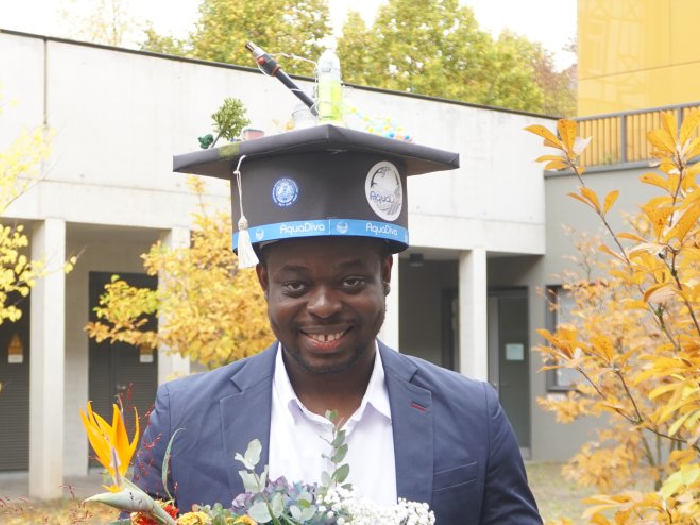
In October Nimo successfully defended his PhD thesis titled: "Tailor-made polymers as tracers for colloids in natural porous media."
Congratulations, Nimo!
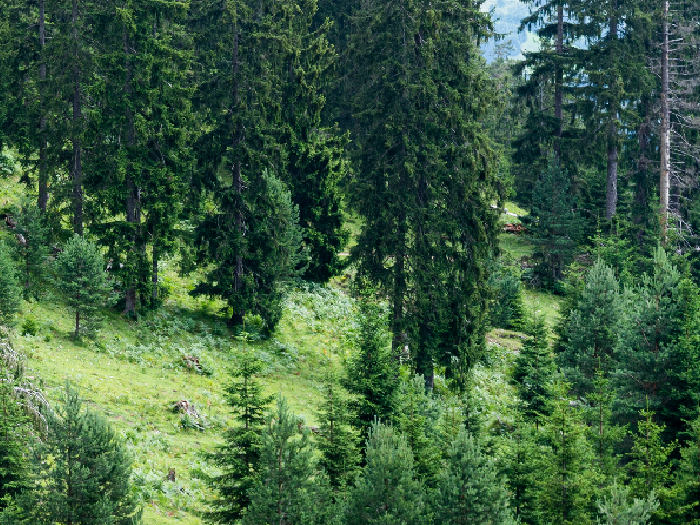
Anna, Peter, Carolina and Almut, together with colleagues from the Plant Ecophysiology group, the University of Lund and the Technical University of Munich, published the study "The impact of changing forest composition in Europe - longest carbon turnover time in unmanaged and broadleaved deciduous forests" in the journal PLOS ONE. The modelling study uses LPJ-GUESS to simulate different management scenarios in European forests, differing in the type of species replanted after harvesting. The full article is available (open access) here.
Learn more
Congratulations to our group member, Carolina Natel, who - together with her teammates -received the Effective Communicator Award at the ELLIS Summer School: AI for Earth and Climate Sciences for their project, “Self-supervised Learning for Flood Mapping.” Carolina and four other participants collaborated on a research challenge at the intersection of deep learning and environmental science. They proposed the JENA-Autoencoder, an adaptation of a state-of-the-art self-supervised learning method, which incorporates both spatial and temporal context from a triplet of Sentinel-1 images during pre-training.

This year our group retreat took place in Bad Bayersoien.
We discussed topics relevant to the group, like how we can improve communication and collaboration, data management, and the onboarding process.
We also made time for other group activities, such as walks through the peatland and around Lake Soier.

Team members Carolina, David, Peter, Almut, and collaborators published a new study in Geoscientific Model Development, presenting machine learning emulators that speed up predictions of forest carbon stocks and fluxes under climate change by 95%, while preserving the original model's sensitivity to key environmental drivers. This advancement lays the groundwork for assessing forest-based climate mitigation strategies, which often rely on computationally intensive simulations within complex modelling frameworks such as LandSyMM.
Learn more
Our team members Jianyong, Almut, Peter, and Martin, along with other collaborators, have just published a new study in Geoscientific Model Development titled: “Soil nitrous oxide emissions from global land ecosystems and their drivers within the LPJ-GUESS model (v4.1)”. This work introduces a nitrification-denitrification module into the LPJ-GUESS land surface model, enhancing its ability to simulate emissions of nitrous oxide (N2O)—a potent greenhouse gas—from soils across the globe.
Learn more
Jens defended on April 28 successfully his Ph.D. thesis, entitled Ecosystem Feedback from Animal-Vegetation Interactions: A Modeling Approach. Congratulations!

Helena, Isabel, and Almut have published a new study in the journal Ecological Informatics titled Analysing the impact of large mammal herbivores on vegetation structure in Eastern African savannas combining high spatial resolution multispectral remote sensing data and field observations. The study explores the effect of large mammal herbivores on savanna vegetation using various measures of satellite images and collected field data.
Learn more
Almut and former team members published the study "Non-radiative effects dominate the local surface temperature response to land-cover change - Insights from a semi-empirical model" in the Journal of Environmental Management. It presents a simplified approach developed by Benjamin and Lorenz to examine how changes in land cover, such as deforestation and afforestation, impact local surface temperatures.
Learn more

This year's update of the global carbon budget is published. We contributed again with LPJ-GUESS to this annual international exercise that quantifies the five major components of the global carbon budget and their uncertainties. The paper describes and synthesizes the datasets and methodologies applied, and their uncertainties.
Global fossil CO2 emissions have risen by 0.8% in 2024, reaching 37.4 GtCO2, with increases mainly from oil, gas, and international transport, while emissions in the EU and the U.S. decline. Land-use changes continue to contribute to CO2 emissions, with deforestation remaining a major source, though forest regrowth offsets some of the impact. The atmospheric CO2 concentration is projected to reach 422 ppm, with ocean and land carbon sinks showing variability due to climate conditions, including El Niño and increased wildfire activity.

Conservation is seen as a key measure to stop and reverse biodiversity loss, as well as a strategy to support global climate change mitigation since the reduced deforestation rates and ecosystem restoration enhance carbon stocks. However, it is also controversial due to potential societal impacts, such as competition for land and food security.
Learn more
Read Carolina's interview about her participation in ELLIIT's five-week focus period this autumn:
Learn more
Almut and two other researchers from KIT are among the most cited researchers worlwide.

Congratulations! One of the two VFF-IFU Sponsorship Awards 2024, announced by the Presidential Board and the Evaluation Committee of VFF-IFU e.V. ('Friends of IFU'), goes to Anita Bayer, Sven Lauterbach and Almut Arneth for their publication about benefits and trade-offs of optimized global land use. See also News in October 2023.
Learn more
We contributed to an analysis led by colleagues from the Land-use change and climate team on how advanced photovoltaic technologies could counteract the reducing effects of changes in solar radiation and rising temperatures on the global solar photovoltaic potential.
Learn more

On October 8-9, our institute hosted the annual General Assembly of the Naturance project. The assembly gathered together representatives from all partner organizations to present updates on ongoing activities and discuss the next steps for the project. Naturance explores the technical, financial, and operational feasibility of integrating disaster risk financing with nature-based solutions.
Learn more
Anna won, jointly with her team-mate Matt from our Frankfurt colleagues, the LPJ-GUESS “Distinguished User Award” at the LPJ-GUESS community meeting. The winning team (the “Outlanders”) showed both in-depth knowledge of the LPJ-GUESS code and variables, but also convinced the jury with creative 'out of the box' thinking when solving anagrams and proposing memes. Congratulations!

Aim of our retreat in Tutzing at Lake Starnberg was team-building and better ways of communication.
The title ‘Stimulating joyous and fruitful cooperation ’ was program
and during many individual and group discussions, different important agreements were reached for the entire working group.
A positive side effect was, of course, that we were all able to get to know each other better, especially the new team members.

Almut and other authors published an article in Science about the question: How will future climate change and land-use change impact global biodiversity and ecosystems? A model-intercomparison study assesses their relative importance.
Learn more
Almut has been awarded the Order of Merit of the State of Baden-Württemberg for her research work linking climate science and biodiversity.
Learn more
Adrien defended on April 15 successfully his Ph.D. thesis, entitled Improving Permafrost Dynamics in Land Surface Models: Insights from Dual Sensitivity Experiments.

The Karlsruhe Institute of Technology (KIT) - Campus Alpin in Garmisch-Partenkirchen, offers a 7-day international Summer School (3-4 ECTS) on the topic of land use and ecosystem change. Participants will learn about a wide range of issues related to land use change, socio-ecological systems, ecosystem functioning, and modelling techniques.

The annual update on the global carbon budget, which is led by the Global Carbon Project is published. The analysis shows that global carbon emissions from fossil fuels have risen again in 2023 – reaching record levels, fossil carbon dioxide (CO2) emissions are projected to reach 36.8 billion tonnes in 2023, up 1.1% from 2022. Our team has again this year contributed with LPJ-GUESS simulations to these regular updates.
Learn more
Doubling food production, saving water and increasing carbon storage at the same time - this sounds paradoxical, but would be theoretically possible, at least according to the Earth's biophysical potential.
Former team member Anita Bayer, Sven Lauterbach and Almut have published ‘how’ in the Proceedings of the National Academy of Sciences.
More and more people live on earth, more food is needed, and food can now be transported around the world in a short time. However, as the study shows, the historically developed systems of food production do not reflect the biophysical potential of our ecosystems. Accordingly, food is not produced where it would be most efficient in terms of land, water and CO2. Instead, according to the study's authors, forests continue to be cleared for cropland and pasture, and fields in arid regions are irrigated - measures that have a massive negative impact on water availability and carbon storage.
But what would happen if fields, pastures, and natural vegetation were instead moved to where it would be most efficient? If cropland were restricted to areas where irrigation is not needed?
The result: spatial restructuring alone could increase food production by an average of 83 percent, while increasing the amount of water available by eight percent and CO2 storage by three percent. It is a theoretical experiment, which does not consider the numerous societal factors that are at play in the global good system. Still, the study highlights that there is potential to maintain and increase agricultural yields in a globalised world through better considering local growing conditions while at the same time limiting land consumption.
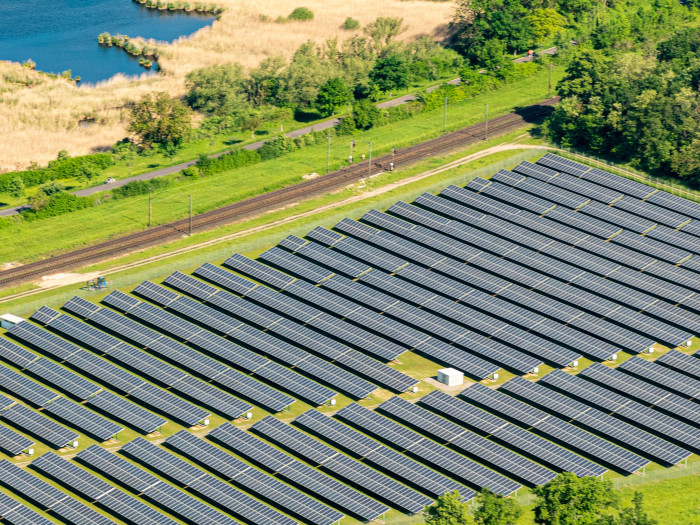
This article, published by Ankita Saxena, Calum Brown, Almut Arneth and Mark Rounsevell in Environmental Research Letters is about how big the potential of solar photovoltaic energy can be in the future and by which parameters it is influenced.
Solar photovoltaic (PV) energy has an immense potential for making the transition to a fossil-free, but still reliable and economical energy supply.
But how does the PV potential change with climate change, e.g. higher temperatures? How is it influenced by technical progress? And are these changes the same all over the world?
All these questions need to be considered in order to estimate the potential solar energy that can be generated in the future.

Almut speaks in an interview to Michelle Yeoh on Forests and Climate Change.
The podcast can be listened to here.
Learn more
EURASC aims to promote fundamental research and excellence in science and technology with a vision of Europe as a whole, transcending national borders.
Learn more
Jianyong defended on May 12 successfully his Ph.D. thesis, entitled Assessing the effects of agricultural management practices on crop ecosystems with the LPJ-GUESS model.

Team members Jianyong Ma, Almut Arneth, Peter Anthoni, Sam Rabin, and Anita Bayer published an article in Earth’s Future assessing the global influence of cover crops on yields and cropland carbon and nitrogen balance with the Dynamic Global Vegetation Model, LPJ-GUESS.
Increasing crop productivity while maintaining a healthy environment is a major challenge for global agriculture. Cover crops, mostly grown during the fallow period and plowed into in soils, are expected to improve soil fertility and crop yields while reducing chemical fertilizer use, but their overall impacts on global croplands remain unknown. This study investigates the long-term influence of cover cropping on three ecosystem service indicators across four dominant farming systems (wheat, maize, rice, and soybean). Results show that adoption of cover crops can enhance soil carbon stocks, which would contribute to slowing climate change, and benefit environments through reducing nitrogen pollution to water bodies. Among the modelled cover crop species, legumes show higher potential in increasing cash crop yields than non-legumes, but the effect is highly dependent on the crop rotation, chemical fertilizer rate, and management duration. These results highlight that proper implementation of legume cover crops can support food security and environmental sustainability in global agricultural ecosystems.

Almut is co-author of a review in Science that is an outcome of the IPBES/IPCC workshop in 2020.
The coupled global climate and biodiversity crises and their societal impacts concern land, freshwater, and ocean ecosystems alike but are insufficiently tackled by current actions, as identified by assessments of both the IPCC (Intergovernmental Panel on Climate Change) and IPBES (Intergovernmental Science-Policy Platform on Biodiversity and Ecosystem Services). None of the 20 2011–2020 Aichi biodiversity targets and none of the mileposts on climate trajectories intended to limit warming to 1.5°C have been met.

The European Union's Biodiversity Strategy for 2030 seeks to protect 30% of land, with 10% under strict protection, while building a transnational nature network. But, how can this influence land use change and ecosystem services provision in the future? A new paper, by Andrea Staccione and Almut Arneth in collaboration with the Land Use Change and Climate Research Group, explores the possibility of extending a network of protected areas and derived benefits. Results show that prioritizing connectivity when implementing new protected areas could achieve the strategy's targets without compromising the future provision of ecosystem services, including food production, in Europe. The Eu protected area targets appear to be achievable, but adaptation needs should be considered in the wider land system.
Learn more
Extending protected areas (PA) to 30% of land and seas is the target in the Kunming-Montreal Global Biodiversity Framework that has received most attention. This paper, led by Almut, presents the ‘Green Shoots’ framework to help assess the complex interactions between biodiversity and other sustainability objectives. Critically, the focus on area coverage obscures that considering PA effectiveness is equally important. Expanding PAs can create synergies or trade-offs with food and climate mitigation depending on how PAs are implemented. Given limited progress on PA effectiveness in the past, serious concerns exist about whether the anticipated benefits for biodiversity and other sustainability objectives will be realized.
Learn more
We spent the 4th and 5th of October 2022 on top of Germany - on the Schneefernerhaus right next to the peak of Zugspitze. Together with the Land Use Change & Climate Research Group of Prof. Mark Rounsevell, we exchanged project progress, recent research questions and future ambitions of both working groups.
Learn more
The annual update on the global carbon budget, which is led by the Global Carbon Project is published, and was presented also at the UNFCCC COP at Sharm el-Sheikh. The analysis shows that -despite political commitments to limit global warming- emissions continue to increase and are projected for 2022 to be 40.6 Gt CO2, about similar to pre-Corona levels of 2019. Our team has again this year contributed with LPJ-GUESS simulations to these regular updates.
Learn more
Team members David Martin Belda, Almut Arneth and Peter Anthoni published an article in Geoscientific Model Development describing major developments into a state-of-the-art Dynamic Global Vegetation Model, LPJ-GUESS. These developments lay the ground work to use this tool to study complex interactions between the climate and the atmosphere. The land ecosystems and the atmosphere are part of the same system, and are interconnected across a wide range of spatial and temporal scales. These interactions are bi-directional; changes in climate (e.g. temperature or precipitation trends) will affect the ecosystem, but changes in the ecosystem (e.g. deforestation of large areas to plant crops) will also affect the local climate through biophysical interactions, and have an impact in the global carbon cycle. The changes implemented into LPJ-GUESS allow it to compute energy and water fluxes between the land ecosystem and the atmosphere in short (sub-daily) time scales, which is exactly what will allow it to communicate with atmospheric models "in real time". The energy and water fluxes calculated by the new schemes were evaluated against observations at a selection of sites with satisfactory results.
Learn more
Team members Jens Krause, Almut Arneth and Peter Anthoni published an article in Ecological Modelling. We investigated the impacts of a complex, process-based DGVM on simulated animal populations. The Madingley model, a model of multi-trophic functional diversity, was exerted to natural vegetation which was simulated by LPJ-GUESS. The simulations' results were compared to the default Madingley version. We showed that not only the vegetation simulated by LPJ-GUESS is more realistic than the vegetation parameterised by Madingley’s default version - for the first time, we also could reproduce power-law relationships between the ecosystem’s net primary production and both the herbivores’ individual body masses and consumption rate. Our results are the foundation for further model development and underline that developing process-based model systems is a viable way to assess multi-trophic interconnections between animal populations and the ecosystems vegetation. This is Jens' first paper from his Ph.D. research.
Learn more
On 30. June the kick-off meeting of the KIT Womens Professors Forum took place in Karlsruhe. The KIT Women Professors Forum sees itself both as a community and as a strategic platform for the female professors at KIT. The goals of the network, inspired by WPFs at ETH Zurich and MIT in Boston, include informal exchange and mutual support, increased participation of female professors in relevant committees and decision-making processes, support of the implementation of KIT's diversity strategy, and networking with similar initiatives at home and abroad. To this end, the members of the forum organise a series of regular and unscheduled activities, for example, lunchtime lectures, discussion events and joint excursions. Almut is one of the elected members of the WPF Executive Board.
Learn more
The report repeats the warnings the scientific community has been expressing for years. Global warming, reaching 1.5°C in the near-term, is expected to cause unavoidable increases in multiple climate hazards and present multiple risks to both ecosystems and humans. The magnitude and rate of climate change and associated risks depend strongly on near-term mitigation and adaptation actions, and projected adverse impacts and related losses and damages escalate with every increment of global warming. Almut was Lead Author in Chapter 2 of the report on Terrestrial and Freshwater Ecosystems.
Learn more
The first paper in Jianyong's thesis about the significant importance of biological nitrogen fixation (BNF) from grain legumes in global agricultural ecosystems has now been published in GMD, congratulations to Jianyong!
Learn more

Almut is one of the Gottfried Wilhelm-Leibniz Price winners 2022.
Read more about the Leibniz price here.
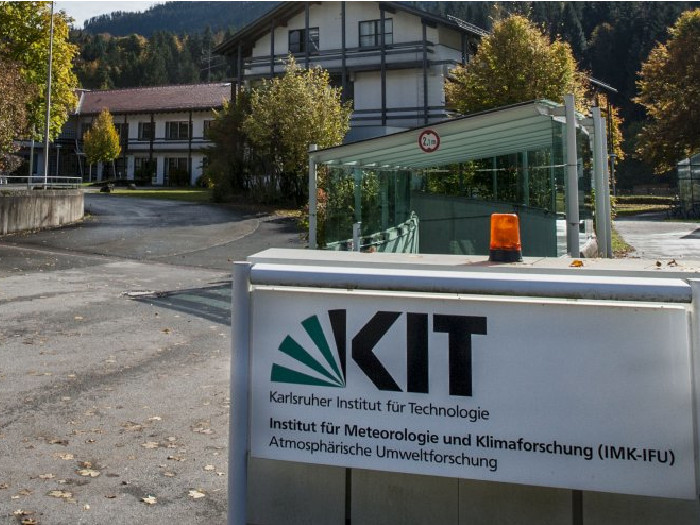
Almut in an Interview with the State initiative for women in STEM careers about biodiversity, climate change and about her career as biologist.
Learn more
The annual update on the global carbon budget, which is led by the Global Carbon Project is published. Our team contributes to these regular updates with LPJ-GUESS simulations.
Learn more
On October the KIT Women Professors Forum was launched by its current members.
Learn more
Almut led an invited review paper to ARER that summarises the multiple challenges of land degradation and highlights the many co-benefits arising from restoring degraded lands.
Learn more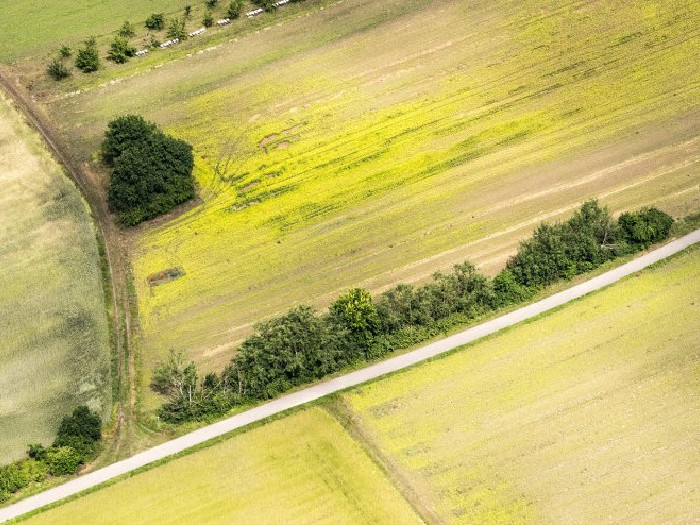
Biodiversity loss and climate change are both driven by human economic activities and mutually reinforce each other. Neither will be successfully resolved unless both are tackled together.
Learn more
Team members Anita Bayer, Almut Arneth and Peter Anthoni published a study in Earth System Dynamics demonstrating the large variability in ecosystem service indicators caused by diverging future land-use scenarios.
Learn more
Prof. Almut Arneth reports on how she proceeds as a Humboldt Scout in the search for talent.
Learn more
The annual update on the global carbon budget, which is led by the Global Carbon Project is published. Our team contributes to these regular updates with LPJ-GUESS simulations.
Learn more
A considerable number of existing and proposed post-2020 biodiversity targets by international organizations are at risk of being severely compromised due to climate change, even if other barriers such as habitat exploitation are removed argue the authors of a study led by Almut. According to their analysis published in PNAS, global warming accelerates the loss of biodiversity. Vice versa, measures to protect biodiversity may also mitigate the impacts of climate change. The authors suggest that flexible approaches to conservation would allow dynamic responses to the effects of climate change on habitats and species.
Learn more
Simulations done with LPJ-GUESS contributed to this study, published in Nature, which demonstrates the large contribution of N2O emissions from agriculture to the observed increases in N2O emissions.
Learn more
Simulations with LPJ-GUESS done within the FireMIP project contributed to this study in ERL, which investigated the impact of land use change and climate change on vegetation biomass in China.
Learn more
Almut participated in the GIZ Web Talk "Biodiversity Matters: Die biologische Vielfalt bewahren – unsere Zukunft sichern". Read more about her input to the discussion.
Learn more
We contributed to an international study, led by our former team member Tom Pugh, published in Nature Climate Change which demonstrates the large importance of accounting for frequency and extend of disturbance for carbon cycling in forest ecosystems. The work highlights how even small changes in disturbance interval, for instance through climate change or human forest management, would impact today’s forest carbon sink.
Learn more
More than half of the carbon sink in the world’s forests is in areas where the trees are relatively young – under 140 years old – rather than in tropical rainforests, an international team of researchers including Almut Arneth shows. These trees have typically ‘regrown’ on land previously used for agriculture, or cleared by fire or harvest and it is their young age that is one of the main drivers of this carbon uptake. Previously it had been thought that the carbon uptake by forests was overwhelmingly due to fertilisation of tree growth by increasing levels of carbon dioxide in the atmosphere. However, the analysis published in PNAS demonstrates that areas where forests are re-growing take up large amounts of carbon not only due to these fertilisation effects, but also as a result of their younger age.
Learn more
The annual update on the global carbon budget, which is led by the Global Carbon Project is published. Our team contributes to these regular updates with LPJ-GUESS simulations.
Learn more
An article published in Science by authors of the Global Assessment of the IBPES warns of the continued over-exploitation of the earth’s resources which are vital for human societies. Evidence across scientific disciplines that was brought together for the report demonstrated unequivocally, that—like climate change—the loss of biodiversity on land, in freshwater and oceans impedes severely our possibilities towards achieving many Sustainable Development Goals. The declining trend in many indicators related to the integrity of natural ecosystems can be turned around through a number of integrated actions that include innovative governance approaches, as well as informed individual decision making.
Learn more
Almut received a Distinguished Visiting International Fellowship under the Western Sydney University Vice Chancellor’s Research Fellowship Programme and will be visiting the Hawkesbury Institute for the Environment at WSU in spring 2019 and 2020 to initial sustained cooperation and joint research activities with Australian colleagues on topics related to the role of terrestrial ecosystems and their management under land-use change and climate change.

A team of researchers including some of our team’s members has published a study titled “The role of global dietary transitions for safeguarding biodiversity” in Global Environmental Change. The study emphasises that diets low in animal products reduce agricultural expansion and reduce agricultural intensity in biodiverse regions.
Learn more
Earth System Knowledge Platform is now online in German
Learn more
The IPCC approved and accepted Climate Change and Land: an IPCC special report on climate change, desertification, land degradation, sustainable land management, food security, and greenhouse gas fluxes in terrestrial ecosystems at its 50th Session held on 2 – 7 August 2019 in Geneva. The approved Summary for Policymakers (SPM) was presented at a press conference on 8 August 2019. Almut Arneth was Coordinating Lead author of chapter 1 in the report and participated in the IPCC plenary session.
Learn more