
.svg)



 |
Almut Arneth - Professor - Group leader
As head of the LEMG team and leader of the Campus Alpin’s division on Ecosystem-Atmosphere Interactions, I focus on how terrestrial ecosystems respond to climate change and land-use change. My work explores how natural and managed ecosystems can contribute to climate change mitigation, with co-benefits for adaptation and broader sustainability goals. I am particularly interested in the role of ecosystem processes and services in shaping land-use decisions within socio-ecological systems. My research also aims to improve the representation and quantification of biodiversity-ecosystem function links in modeling frameworks. I have contributed as an author to IPBES and IPCC assessment reports for many years. Email: almut.arneth∂kit.edu |
 |
Carolina Natel - Deputy group leader
I am a postdoctoral researcher in the Global Land Ecosystem Modelling group at KIT/IMKIFU. My research focuses on understanding and modelling the interactions between climate, land use change and management, and ecosystem functioning, with an emphasis on forest disturbances (e.g. wildfires) and forest carbon dynamics. I develop and apply machine learning and deep learning approaches as core modelling tools to capture complex, nonlinear processes in terrestrial ecosystems. I hold a doctorate in Water Resources and Environmental Engineering from the Federal University of Paraná, Brazil. My research has been supported by fellowships from the Swiss Excellence Scholarship programme, the Alexander von Humboldt Foundation, and the KIT Young Investigator Group Preparation Programme. Email: carolina.moura∂kit.edu ORCID ID: 0000-0003-3103-6789 |
| Peter Anthoni - Scientific programmer
Peter Anthoni obtained his doctorate in atmospheric science at the Oregon State University, USA, and joined the PAI modelling group in 2015 as a scientific programmer. His main tasks involve model development, data analysis, and performing model simulation at HPC centers in Germany. Email: peter.anthoni∂kit.edu |
|
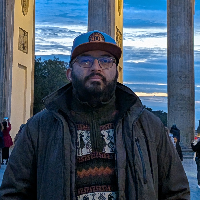 |
Hector Camargo Alvarez - Postdoctoral researcher
I did my bachelor and master degree in agricultural sciences in Colombia (Universidad Nacional de Colombia) and USA (Washington State University), respectively. For my PhD (University of Birmingham, UK) I focused my research in large scale vegetation dynamical modelling, specifically LPJ-GUESS where I worked improving crop simulations but also evaluating the cropland relationships with legacies of previous pastures and natural vegetation covers. I joined the Global Land Ecosystem Modelling group of the Karlsruhe Institute of Technology/IMKIFU in January 2024 with a postdoctoral Alexander von Humboldt fellowship. My interest research at KIT is to evaluate the effect of different climate and environmental pressures on forests and agroecosystems and assesing management activities to mitigate and adapt to those pressures. Email: hector.alvarez∂kit.edu |
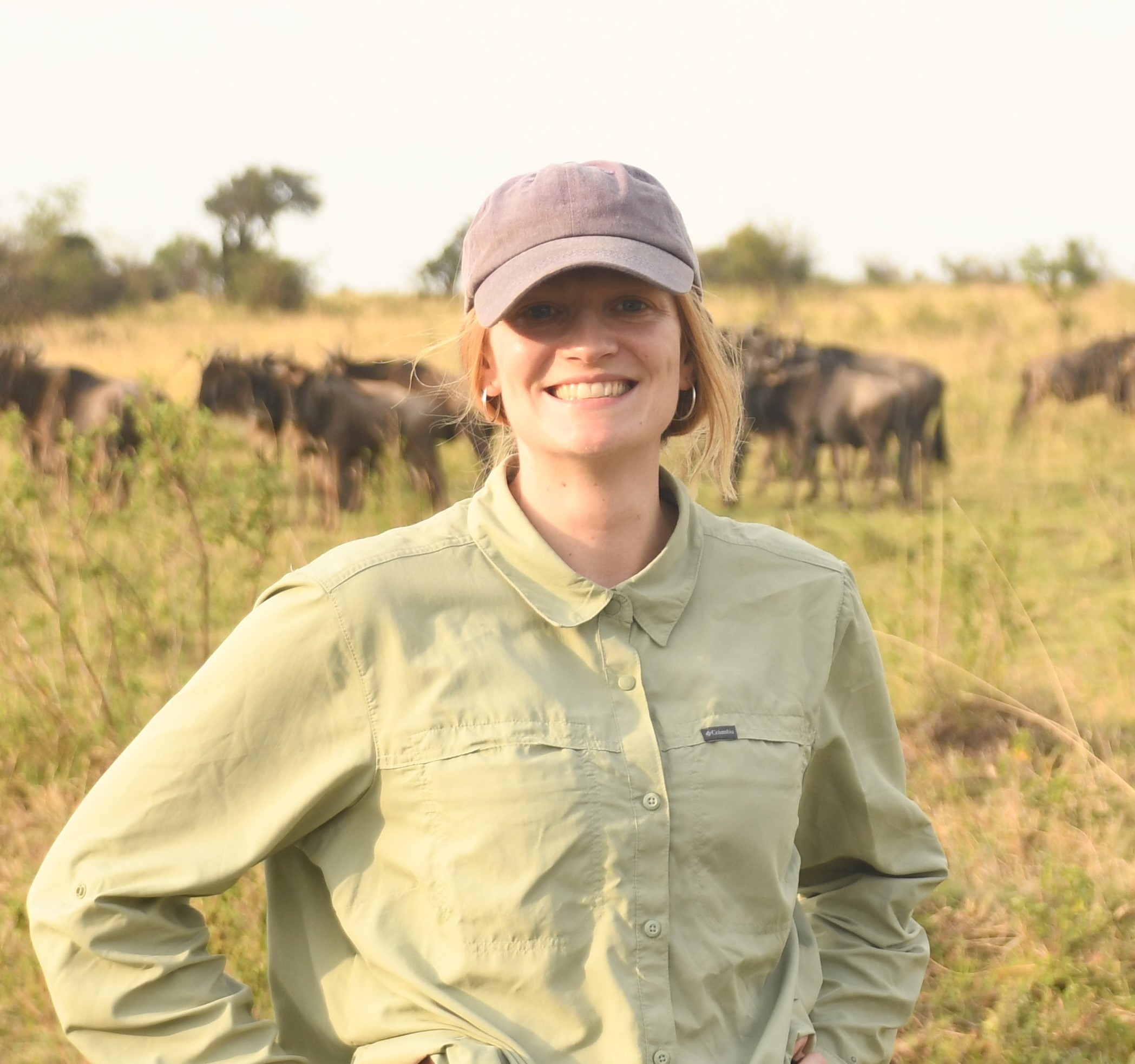 |
Helena Back - PhD student
I started as a master student in the LEMG group and wrote my master thesis with the title: Herbivory in the Savanna - Assessing the impact of large mammal herbivores on the vegetation using PlanetScope data. In October 2023 I started my PhD within the LEMG group. My research focuses on the development of an open-source individual-based ecological model, which aims to investigate migratory grazing systems in the family of ungulates. The focus of this study is the Serengeti Greater Maasai Mara ecosystem, where I am exploring the effects of land use and climate change on the wildebeests' movement and population dynamics. I hold a Master's degree in Geography, complemented by studies in Biology (140 ECTS) at the University of Heidelberg, Carleton University, Ottawa and the University of Innsbruck. I am interested in biodiversity research, population dynamics, and animal movement and ecological modelling in the context of global change. Email: helena.back∂kit.edu |
| Daniel Bampoh - Postdoctoral researcher
My current research interests include but are not limited to questions at the nexus of human-natural coupled systems. As part of the Global Land-Ecosystem Modelling group, I collaborate with colleagues to synchronize and optimize integrated land surface, biogeochemical, socioeconomic and climate models - to explain and predict impacts and feedback of global land use patterns on climate. I received my PhD in Interdisciplinary Ecological Sciences and Engineering from Purdue University. There, I developed Individual based models to examine the influence of behavior (e.g., movement, social), mortality and landscape heterogeneity on the distribution of animal-transported subsidies (i.e., ecological resource and consumer transfers across ecosystems). |
|
 |
David Martin Belda - Scientific programmer
I graduated in Physics and Astrophysics in Spain, after which I moved to Germany to complete my PhD at the Max Planck Institute for Solar System Research in Göttingen. In my thesis I studied how certain plasma flow patterns on the Sun’s surface may affect the strength of the solar magnetic cycle. By the end of my PhD I started taking an interest in Climate Science and the relationship between the Climate system and human activities. Since then I have been working in the Global Land-Ecosystem modeling group at KIT/IMKIFU in Garmisch-Partenkirchen. My work here has focused on expanding the Dynamic Global Vegetation Model LPJ-GUESS into a Land Surface Model suitable for coupled Land-Ecosystem-Atmosphere experiments. This involves implementing various constraints and new physics schemes into LPJ-GUESS, such as energy balance, heat and water transport in the soil or radiative transfer. When ready, this model will allow to study feedbacks between the atmosphere and the slower ecosystem processes, such as population dynamics and trends of the biomass production in the context of a warming climate. Email: david.belda∂kit.edu |
 |
Adrien Damseaux - Postdoctoral researcher
I got my master degree in Geosciences - Climatology from the University of Liege, with a focus on atmospheric physics in the Patagonian region using a Regional Atmospheric Climate Model. Subsequently, I obtained my doctorate at the Alfred-Wegener-Institute in Potsdam, where I studied permafrost dynamics using a Land Surface Model (LSM). My doctoral research aimed to improve the LSM's representation of heat and water exchanges in permafrost areas, with specific attention given to the influence of snow and soil organic matter. As a member of the Land-Ecosystem Modeling group, I work towards the development of advanced model systems, including dynamic global vegetation models, functional biodiversity models, and coupled socio-economic/ecological models. Our common goal is to address the complex issues raised by the intersecting challenges of climate change, land-use change and biodiversity loss. Email: adrien.damseaux∂kit.edu |
 |
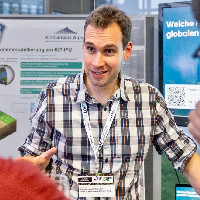
Anna Ferretto - Postdoctoral researcher
I did both my bachelor's in Natural and Environmental Science (University of Parma) and my master's in Environmental Sustainability (Marche Polytechnical University) in Italy, to then leave for Scotland for a PhD in Environmental Science at the University of Aberdeen and the James Hutton Institute. There, I have applied bioclimatic envelope models to assess the impacts of climate change on different peatland ecosystem services. I am interested in everything that deals with nature, which is why I have always changed the topic of my research. I did my thesis in ethology (bachelor), marine biology (master) and peatland ecosystem services (PhD), and my research at KIT is about… forests! I came to IMKIFU as a postdoc thanks to an Alexander von Humboldt fellowship, and I am now continuing to work here in the "WildE" project, which looks at rewilding scenarios in Europe, in terms of trade-offs/co-benefits between different ecosystem services. ORCID ID: 0000-0003-4865-3660 |
 |
Jens Krause - Postdoctoral researcher
I am post-doc at the IMKIFU since June 2025 after defending my thesis at the IfGG in Karlsruhe. My research focusses on ecosystem dynamics, especially the interactions between animals and their ecological habitat. Since the traditional scientific view of ecosystem marginalised the effects of the top of the food pyramid, there is a lot less known about the effects animals imply on an ecosystem when compared to other parts of the biosphere. With my research, I tackle this knowledge gap by coupling two models for the first wholistic, process-based modelling approach that simulates the whole trophic pyramid of terrestrial ecosystems. Thus, I am not only working on LPJ-GUESS (a DGVM) but also the Madingley model (a functional diversity model). Email: jens.krause∂kit.edu |
 |
Nimo Kwarkye - Postdoctoral researcher I am a geoscientist who specializes in numerical modelling. I earned a BSc in Meteorology and Climate Science from Kwame Nkrumah University of Science and Technology in 2017. I then completed an Erasmus Mundus MSc in Groundwater and Global Change, finishing a masters thesis at TU Dresden, where I modelled groundwater–surface water interactions. After that, I earned a PhD in Hydrogeology at Friedrich-Schiller University in Jena, developing custom C++ transport models for simulating solute mobility and interactions below surface. I now work with the LPJ-GUESS model in the LEMG group, investigating how land use change affects CO₂ exchange between ecosystems and the atmosphere. My research focuses especially on reducing uncertainty in CO₂ model estimates. |
 |
Tobias Laimer - PhD student
I'm a PhD student in the global land ecosystem modeling group, with a background in physics and environmental studies from LMU Munich. I'm interested in multiple dimensions of the current climate and ecological crises, especially their interactions and trade-offs inherent in potential solutions. Utilizing its early-stage coupling to CRAFTY for broader socio-ecological perspectives, I work with LPJ-GUESS to explore how different climate and policy scenarios affect terrestrial carbon cycling and ecosystem services in German and European contexts. My first paper reviewed competing demands on European forests under climate change that current policies struggle to resolve. Current projects examine land-based carbon removal pathways in Germany and protected area network expansion across Europe, comparing outcomes across different climate futures and policy configurations. Beyond my PhD research, I contribute to climate policy assessments as Almut’s scientific staff member for Baden-Württemberg's Climate Advisory Council (Klima-Sachverständigenrat). |
 |
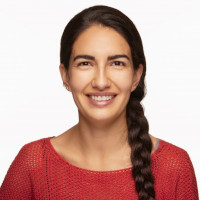
Jianyong Ma - Postdoctoral researcher
I earned my PhD in ecological modelling from the Karlsruhe Institute of Technology in Germany. My research focuses on modelling the impacts of climate change and land-management practices on terrestrial ecosystems, with an emphasis on carbon–nitrogen–water fluxes. During my PhD, I developed and implemented the Biological Nitrogen Fixation (BNF) in legumes into the LPJ-GUESS crop module. I am currently involved in the EU-funded EYE-CLIMA project and the Global Land Nitrogen Budget – Model Intercomparison Project Phase 3 (NMIP3), where I work on simulating nitrous gas emissions by developing soil nitrification–denitrification processes in LPJ-GUESS. Email: jianyong.ma∂kit.edu |
 |
Isabel Pérez Postigo - Postdoctoral researcher I joined the global land ecosystem modelling group in May 2021. Here, I am investigating the effects of large herbivores on the vegetation using remote sensing methods. The aim is to develop a method to measure large scale changes in the vegetation related to ecosystem functions, carbon cycling and ecosystem services. The findings will help to improve the simulation of herbivore effects on vegetation in the model LPJ-GUESS. After a Bachelor in Physical Geography at the University of Erlangen (Germany) and a Master in Environmental Geography at the Universities of Marburg (Germany) and Lisbon (Portugal), I pursued a PhD in Ecology at the University of Guadalajara (Mexico) on alien plants in Western Mexico. My research interests thus combine different aspects from Geography and Biology. More specifically ecosystem functions, plant ecology and interactions with the biotic and a-biotic environment in a spatial and temporal context. |
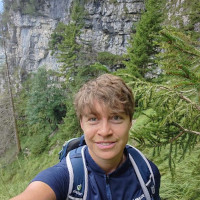 |
Katharina Ramm - PhD student
Katharina Ramm is a PhD student in the Land Use Change & Climate Research Group as well as in the Ecosystem-Atmosphere Interaction Group since October 2020. Her research focusses on quantifying biodiversity loss and developing a human pressure index to better measure human influence on extinction rates. Her scientific interest includes ecosystem services and anthropogenic impact on biodiversity, land cover change and geospatial data analysis with open source tools. Email: katharina.ramm∂kit.edu |
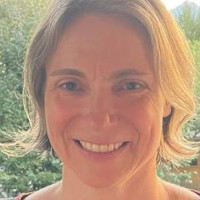 |
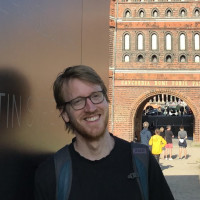
Angelika Schwan - Group Assistance
Since August 2023, I am at IMKIFU as assistance for the Global Land Ecosystem Modelling group. You can contact me with questions about onboarding and websites. Some time ago I studied Geoecology in Braunschweig. During the last years I worked for a non-profit organization in Weilheim i. OB with the aim of supporting the insurance industry on the path to sustainable transformation. Email: angelika.schwan∂kit.edu |
 |
Martin Wittenbrink - PhD student I am a PhD Student at IMKIFU since August 2022. After graduating in Meteorology and Physics of the Earth and Atmosphere at the University of Bonn, I started working at the German Weather Service (DWD) for a research project called “DeepRain”, where I developed spatial precipitation postprocessing methods. At KIT/IMKIFU, I work on the Dynamic Global Vegetation Model LPJ-GUESS and use it for simulations to evaluate different forest management scenarios. My research interest focusses on atmospheric and ecosystem modelling and especially the interactions between those two spheres. |
Former team members
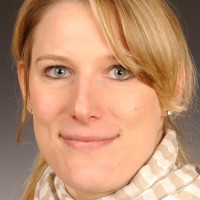 |
Anita Bayer - Postdoctoral researcher
While in the LEMG team, Ani worked on ecosystem dynamics including the services ecosystems provide for humans and the changes in these provisions due to environmental conditions, especially climate and land use. She worked with the dynamic vegetation model LPJ-GUESS in combination with a broad range of global and regional data and analysis approaches (e.g. evaluation of uncertainties in carbon stocks in fluxes due to land use data and representation of land use, global implementation of an improved metric for carbon sequestration, optimization of land use for ecosystem service provision, etc.). Anita joined the group in 2013 after her PhD in hyperspectral remote sensing. Ani left us at the end of 2021. She now works at a small company, OHB, on satellite remote sensing applications. |
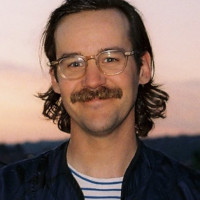 |
Ashton Dickinson - Student assistant
I am a student in the TUM Masters in Sustainable Resource Management program. I joined the IMKIFU in spring 2024 for my internship until spring 2025, and have expanded the internship project into my thesis. For this project I worked to combine LPJ-GUESS SIMFIRE burned area outputs with other data sets to investigate how changes in future fire regimes could impact fire risk. |
| Famke Geißler - Student assistant Student of geography and geoinformatics at the FSU Jena and done an internship with us in summer 2021. During this period, Famke worked together with Sam and Almut on a project of fire risk assessment. Her field of interest includes the effects of climate change on ecosystems and interactions with humans. |
|
 |
Florence Gérard - Student assistant
I am a student in the TUM Masters in Sustainable Resource Management program. I joined the IMKIFU in spring 2024 for my internship until spring 2025, and have expanded the internship project into my thesis. For this project I worked to combine LPJ-GUESS SIMFIRE burned area outputs with other data sets to investigate how changes in future fire regimes could impact fire risk |
| Christine Herschlein - Postdoctoral researcher
Christine’s research was on the effect of management on Carbon pools and fluxes in European forests. She explored with LPJ-GUESS the effects of different harvest regimes and intensities and of planting selected tree species, also outside their natural range. Before joining KIT, Christine completed her PhD in modelling CO2 fluxes from peatlands. The aim was to identify, investigate and understand processes that are most relevant for greenhouse gas uptake and emission in natural and drained peatlands. Christine left the team in summer 2020 and works now at the Environment department at the Rural District Office in Garmisch. |
|
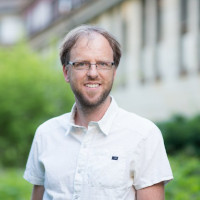 |
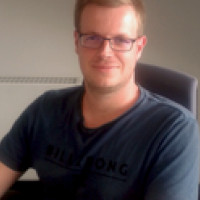
Markus Kautz
Markus Kautz, interested in forest disturbances such as bark beetle outbreaks and how to assess their effects on forest ecosystems, now at the Forest Research Institute Baden-Württemberg, Germany. |
 |
Andreas Krause
Andreas Krause, interested in modelling anthropogenic and natural forest disturbances and potentials for land-based climate mitigation, now at the Technical University of Munich. |
| Moritz Kupisch
I studied Geoecology in Potsdam and Braunschweig with a focus on ecological modelling. After graduation, I joined the crop science group in Bonn and worked with different crop growth models to analyze the relationships between plant growth and carbon and water fluxes under drought conditions. From October 2020 until September 2025, I was working at IMKIFU where I will contribute to the further development of the multi‐trophic functional diversity model Madingley, aiming at an addition of animal C:N stoichiometry. Subsequent simulations will address questions related to the role of animals in terrestrial carbon and nitrogen turnover and the interactions of ecosystem state and function with ecosystem functional diversity. |
|
 |
Valeria Mazzola - Postdoctoral researcher
Valeria joined the Global Land Ecosystem Modelling group as a Postdoc in February 2022. She worked with LPJ-GUESS for the implementation of Bioenergy crops as part of the IsoTech-Land project. Valeria left the team in February 2024 for a position as Peatlands greenhouse gas flux scientist in South Atlantic Environmental Research Institute (SAERI) in Falkland Islands. |
| Dmitry Otryakhin - Postdoctoral researcher
Dmitry is a specialist in modeling and data science with research interests comprised of scientific computing, geospatial modeling and statistical software. He obtained a PhD in mathematics at Aarhus University in 2019. The thesis was focused on simulation of stochastic processes. Later on, he worked on multivariate statistical models at Stockholm University, in particular, applying those with heavy tails to deforestation detection and developing statistical software for methods of mathematical finance. From summer 2022 until 2025 he worked for the Global Land-Ecosystem Modeling group focusing on LPJ-GUESS with high-resolution. |
|
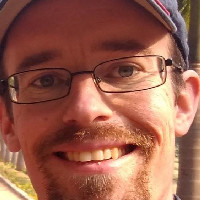 |
Thomas Pugh
Tom Pugh's research seeks to improve understanding of the interactions between vegetation and environmental change at large scales. He is particularly interested in (1) how forest dynamical processes, such as tree mortality, influence climate, (2) how human actions affect these processes and (3) the impact of environmental stresses on terrestrial ecosystems more widely. Tom has moved since to Lund university, Sweden and the University of Birmingham, U.K. More information about his research group can be found at http://bioatmo.wordpress.com. |
| Benjamin Quesada
Benjamin Quesada, PhD, climatologist and professor at Universidad del Rosario (Colombia), co-leader of the Bachelor in Earth System Science, expert in climate-ecosystems interactions, regional climate modelling, extreme weather events and land use impacts. |
|
| Sam Rabin
My interests broadly have to do with the interactions between humans and ecosystems: How society and the natural world affect each other, and how these interactions will evolve over the coming decades and centuries given possible scenarios of population growth, policy options, and technological and management changes. I was also a co-coordinator for the agriculture modeling sector in the Inter-Sectoral Impacts Model Intercomparison Project (ISIMIP). ISIMIP coordinates experiments using models to explore the range of impacts of climate change might have on various natural and social parts of the Earth system, from crop and fishery production to human health and coastal infrastructure. The related ISIpedia project (see https://www.isipedia.org/) translate s the outputs of ISIMIP into country-level summaries designed for use by policymakers and other non-scientific stakeholders; I contributed to the agricultural section. I completed my PhD in Ecology & Evolutionary Biology at Princeton University in April 2016, under the guidance of my adviser, Steve Pacala. There, I developed a global fire model that, for the first time, included a simulation of the ways people manage cropland and pasture using fire. Iworked within the LM3 land and vegetation model run by the NOAA Geophysical Fluid Dynamics Laboratory (NOAA-GFDL). Sam has now taken up a position in the US at Rutgers University.
|
|
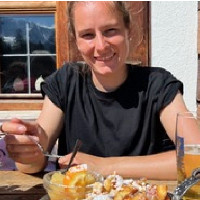 |
Aglaja Roth - Student assistant
I worked on my Master's thesis at the LEMG group from April to September 2025, working on extreme wildfires in Europe. My research involves combining different remote sensing datasets to analyse trends in the occurrence of these extreme events and how fire intensity is related to other environmental parameters. I am currently enrolled in a Master's degree in Remote Sensing and Geoinformatics at KIT in Karlsruhe and am particularly excited about working with satellite data as it allows me to analyse large-scale patterns and changes over time that would otherwise be difficult to capture. |
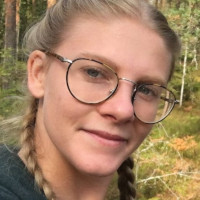 |
Andrea Staccione - Postdoctoral researcher
I worked with the Global Land Ecosystem Modelling group from October 2022 until September 2025. I am involved in the NATURANCE project, which aims to study and improve the feasibility and performance of solutions that are built upon and combine disaster risk financing, insurance and investments with nature-based solutions. I was also collaborating with the Euro-Mediterranean Center on Climate Change in the Risk Assessment and Adaptation Strategy division, based in Venice (Italy). After my Bachelor and Master degree in Environmental Science, I continued my studies doing a PhD in Science and Management of Climate Change at Ca’ Foscari University of Venice (Italy). My research focused on Nature-based solutions (NBS) network as viable solutions for climate change adaptation and disaster risk reduction, looking at the role of NBS spatial connectivity to enhance ecosystem services and support climate resilience. To finalise my PhD, I spent a visiting research period here at IMKIFU collaborating with both Global Land Ecosystem Modelling and Land Use Change and Climate Research groups. |